Risk of ruin simulator for the house and player
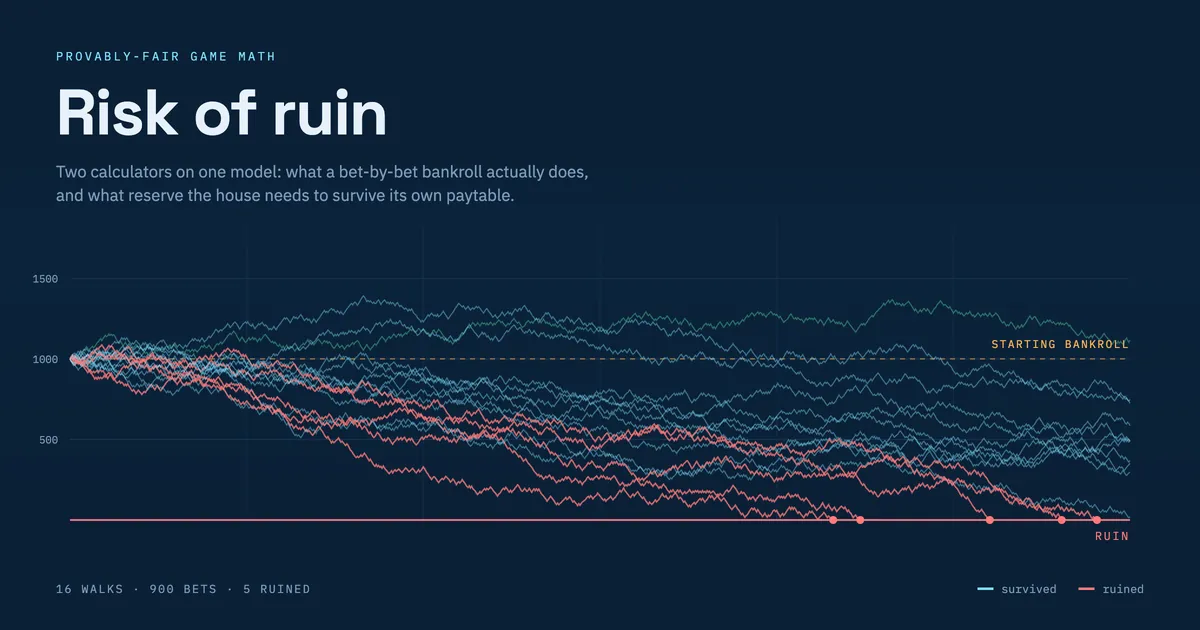
Bet Simulator and Risk of Ruin calculator for the house, same concept for trading and investment.
casinomathriskruinsimulatorcalculatorvariancebankrollpayoutmultiplier
article
Casino Math Toolkit
Two calculators sharing one model: what happens to the player’s bankroll bet by bet, and what bankroll the house needs to survive its own paytable. Runs entirely in your browser — no dependencies, no network.
Setup Starting capital Bet size same $ amount every bet RTP (%) Payout multiplier (on win) Bets per run Runs (players) House capital House sessions 0 / 00% Configure the game and press Run simulation. House P&L RNG variance House bankroll house survived house busted starting capital Capital paths survived busted expected trend (ignores ruin) Final capital distribution Solve for Average bet size Drives revenue (edge × turnover). Not what drives ruin. Max bet allowed RTP (%) House bankroll Max win (gross payout ceiling) Target risk of ruin (%) The ruin probability you are willing to accept over an indefinite horizon. Ruin is driven by exposure per unit of bankroll, and that comes from two independent directions. At high multipliers the danger is one rare huge payout, so max win governs. At low multipliers each adverse event is small but frequent, so a losing streak governs and max bet is what matters. Capping only one leaves the other open — so risk here is always computed on the max bet. Binding constraint Risk matrix — max bet × multiplier Risk of ruin at your bankroll and RTP. Risk climbs on both axes; no safe corner is reachable by controlling only one.How the variance is calculated
How risk of ruin is calculated
The house wins the stake B on a losing bet and pays out max win W on a winning one, so its net loss on a win is (W − B). Win probability follows from the paytable:
p = RTP × B ÷ W (so M = W / B)Note that p × W = RTP × B regardless of W. The house edge per bet is always B × (1 − RTP) — max win never changes expected profit, only volatility. That is the entire point of this calculator.
Adjustment coefficientRisk of ruin comes from the Lundberg coefficient r, the positive root of:
(1 − p)·e−rB + p·er(W−B) = 1 P(ruin | bankroll X) ≈ e−rXThis is used instead of a normal approximation because the house’s risk here is rare large payouts rather than smooth diffusion — a Gaussian model materially understates the tail. Ruin probability decays exponentially in bankroll, so every additional ln(2)/r of capital halves it.
Two directions of dangerExposure per unit of bankroll can arrive two ways, and capping one leaves the other open. At high multipliers p is tiny and each win is enormous, so ruin is a single-event risk and max win governs. At low multipliers each win costs little but happens most of the time, so ruin arrives as a losing streak and max bet governs.
A worked case: bet 10,000 at 1.1× gross with RTP 99% means p = 90%. Each win costs the house only 1,000 — but on a 10,000 bankroll, ten consecutive wins clears it, and P(ten in a row) is 34.9%. True risk of ruin is 82.3%. No payout cap helps here; only a lower max bet does.
A useful sanity rule independent of multiplier: keep max bet under roughly 1–2% of bankroll, then layer the multiplier and absolute-payout caps on top for the high-multiplier tail.
Why the solver, not a shortcutA common approximation, r ≈ 2(1−RTP)/(RTP·W), is a diffusion limit valid only when wins are rare. At 50× and above it is accurate to about 1%; at 2× it is off by a factor of 2, and at 1.1× by a factor of 10. This tool always solves the exact equation above, so it stays correct across both regimes.
Inverse modeSolving for max win inverts the same relation numerically: risk of ruin increases monotonically with W (bigger ceiling, fatter tail), so the solver bisects on W until the resulting ruin probability matches the target.
Three caveatsThis is an indefinite horizon — over a finite operating window the real figure is lower. It assumes no withdrawals; if you pull profit out, the bankroll stays flat and true risk is higher. And ruin means zero, whereas your real constraint is the drawdown that triggers a covenant or forces you to shut the game off. Treat every number here as a floor.