Decline of Strings
One of the most exciting theories in the past 30 years is String theory and subsequently superstrings and m-theory but after 30 years of fight it seems that community is giving up and world is not symmetric !
string theorysuperstringsm-theoryhigh-energy theoryholographyquantum informationcondensed matterbibliometric studyarxivinspire-hep
article
The rise and decline of string theory publications
String theory is widely described as a field in decline. The publication record only partly supports that. Absolute output in its home category is flat to rising; what collapsed is the label, and — in one subfield specifically — the activity itself.
Primary category: hep-th Sources: arXiv year statistics · INSPIRE-HEP · SLAC/SPIRES · changepoint analysis Solid teal — retrieved count from a named source Hatched crimson — reasoned estimate, not retrieved ↑ Absolute hep-th output 3,331 new submissions in 2011 → 4,092 in 2025. No collapse. Formal high-energy theory is producing more papers than it did fifteen years ago. Retrieved · arXiv ↓ The explicit string label The latent “string theory” topic peaked in the late 1990s and slowed thereafter, while the corpus around it kept growing. String phenomenology fell hardest. Retrieved · changepoint study → Migration explains the gap Cross-listings into hep-th rose from 2,391 to 4,086 over the same period — the work is diffusing into holography, quantum information, and condensed matter. Retrieved · arXiv 20,000INSPIRE citations to Maldacena's 1997 AdS/CFT paper, crossed September 2024Retrieved · most-cited HEP paper ever 281,891HEP abstracts analysed in the one directly relevant changepoint studyRetrieved · 1995–2020 9 → 1US string-theory faculty hires per year, 1999–2001 versus 2011Retrieved · Poppitz series ~2005Estimated peak of the explicit string-theory labelEstimate Fig. 01The category did not empty out
Retrieved counts from arXiv's own per-year statistics. Only four years in this window were pulled to database exactness, so the connecting segments are drawn dashed — they are interpolation, not data.
arXiv hep-th — new submissions and cross-lists Retrieved · 4 years Solid markers are retrieved values; dashed segments between them are interpolation and carry no evidential weight. The cross-list line rising to meet the primary line is the single most important pattern on this page.| Year | New articles | Cross-lists | Ratio |
|---|---|---|---|
| 2011 | 3,331 | 2,391 | 0.72 |
| 2018 | 3,667 | 2,805 | 0.76 |
| 2024 | 4,042 | 3,756 | 0.93 |
| 2025 | 4,092 | 4,086 | 1.00 |
By 2025 a paper was as likely to arrive in hep-th as a cross-list from another primary category as it was to be filed there natively. That is what topical diffusion looks like in the submission record.
Fig. 02Diffusion, measured
The cross-list ratio is the cleanest available proxy for the relabeling thesis: it rises when hep-th becomes a secondary tag on work whose home is elsewhere.
Cross-lists per new hep-th article Retrieved Derived directly from the retrieved counts above. A ratio approaching 1.0 means formal high-energy theory has become a service discipline for condensed matter, quantum information, and gravity as much as a destination in its own right. Fig. 03The long arc, and where the decline actually sits
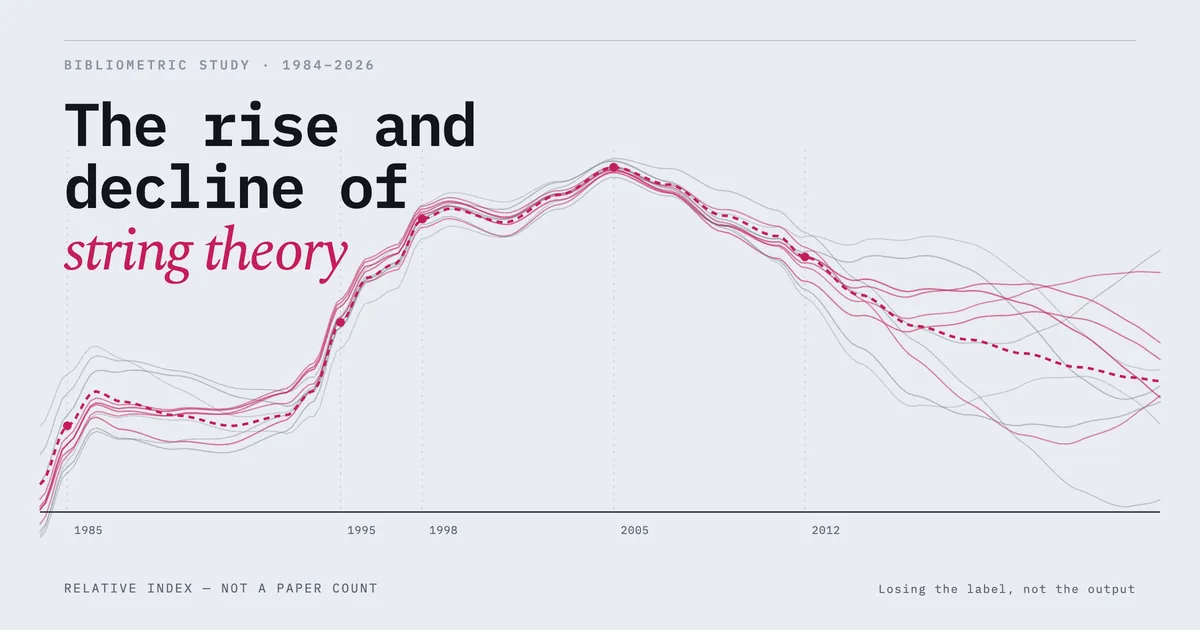
A schematic of the explicit string-theory label across four decades, indexed to its own peak. This is the “rise and decline” curve — and it is an inferred shape, not a retrieved series.
Explicit string-theory label — relative index, peak = 100 Estimate · shape only Indexed rather than counted, because no per-year label series was retrieved. The vertical axis carries no paper counts and should not be read as one. What the curve encodes is the sequence and relative magnitude of the known events, not their absolute volume.Two revolutions build the rise: the 1984–85 anomaly-cancellation era, then the 1994–95 duality period. The 1997 AdS/CFT correspondence resets the field's direction and carries it to a plateau, which the 2003 KKLT construction and the landscape debate push to a mid-2000s high.
The decline begins before the LHC, and steepens after it. The 2012 Higgs discovery without superpartners removed the near-term experimental hook for string phenomenology — the subfield where a genuine contraction, not merely a relabeling, is defensible.
Fig. 04Where the activity went
Labels that rose as the string label fell, with the datable results that launched them. The years are retrieved; the band widths are qualitative and carry no count.
Label trajectories and milestone results, 1995–2026 Dates retrieved Vertical rules mark the three composition changepoints detected across ~282,000 HEP abstracts: August 1998, May 2008, and August 2011 — corresponding to AdS/CFT, the bootstrap and amplitudes revival, and the post-LHC pivot.1997 — Maldacena, hep-th/9711200. 2003 — KKLT (hep-th/0301240) and Susskind's anthropic landscape (hep-th/0302219). 2005 — Vafa's swampland (hep-th/0509212), dormant for a decade.
2008 — Rattazzi, Rychkov, Tonni and Vichi revive the numerical conformal bootstrap; the amplitudes program ramps in parallel. 2018 — the de Sitter swampland conjecture (1806.08362) triggers a rapid burst. 2019–20 — islands and replica wormholes pull quantum-information work back toward string-adjacent gravity.
The hiring signal — where decline is unambiguous
Faculty hiring is a lagging indicator of a field's confidence and a leading indicator of its next decade of output. Here the decline is real and not a labeling artifact.
US string-theory faculty hires per year Retrieved Poppitz US HEP-theory hiring series. In 2011, lattice hires exceeded string hires for the first time since 1994. Landmark papers by citation count Retrieved · approximate Note the scale: the field's centre of gravity is still a paper from 1997.The Strings conference — annual since 1988 — has run at roughly 200 to 400 in-person participants and now brands itself for the “extended string theory community,” explicitly spanning quantum information, condensed matter, and mathematics. The rebrand is institutional, not merely bibliometric.
Alternative quantum-gravity programs are not absorbing the displaced. Loop quantum gravity, asymptotic safety, and causal set theory remain small and roughly flat in gr-qc. The migration ran within hep-th, not out of it.
Three things happening at once
The common error is to collapse them into a single claim about whether string theory is “dying.” They have different evidence bases and different degrees of certainty.
Well supportedAbsolute hep-th output is flat to rising. Retrieved arXiv counts, four exact years. There is no collapse in formal high-energy theory volume.
Well supportedString phenomenology genuinely contracted, sharpest after the 2012 Higgs-without-SUSY result — corroborated independently by the hiring series. This is the real decline, and it is a subfield rather than the whole field.
Supported, but the weakest legRelabeling explains most of the apparent decline. The cross-list ratio and the changepoint study both point this way, but no per-year label series was retrieved. This is the claim most in need of the INSPIRE queries below.
The accurate one-line reading: string theory is not declining in absolute output. It is losing its label, and — in phenomenology specifically — losing genuine activity.
MethodWhy the sources disagree, and one trap specific to this topic
- The labeling trap. A title/abstract search for “string theory” will show a steeper decline than the true activity, because migration to other banners is the dominant effect. This is the failure mode specific to this question and it is severe.
- hep-th ≠ string theory. The category also houses formal QFT, integrability, amplitudes, bootstrap, and quantum gravity. Using it as a proxy systematically overstates string volume; the true string-specific curve peaks earlier and falls further.
- Cross-listing means one paper can be counted under hep-th, cond-mat, and quant-ph simultaneously — which is exactly why the rising cross-list share is a signal rather than noise.
- Preprint and journal double-counting inflates Scopus, Web of Science, and Google Scholar. INSPIRE deduplicates and is the most curated source for this community.
- The late-2025 spike. Monthly hep-th primaries ran anomalously high at the end of 2025 (491 in December). This may reflect modification-date counting artifacts or an influx of AI-assisted submissions. Do not treat the newest monthly figures as clean growth without verification.
Completing the study
- Run the INSPIRE label-trajectory queries. Per year 1985–2026,
hits.totalon title/abstract for each of: string theory, superstring, M-theory, AdS/CFT, holography, swampland, string phenomenology, string landscape, compactification, brane, conformal bootstrap, scattering amplitudes, celestial holography. This single dataset converts Fig. 03 from an inferred shape into a measured series and is the largest gap in the current draft. - Complete the hep-th hard-count series for 1991–2026 from the per-year statistics pages. Only four years are exact here. Plot cross-list share as the headline diffusion metric.
- Quantify the phenomenology contraction directly, via INSPIRE counts and by extending the hiring series past 2011. This is where a real decline exists and it deserves its own figure rather than a shared one.
- Benchmark against total arXiv growth. arXiv took ~181,630 submissions in 2021 and physics fell below half of all intake back in 2017. Framed that way, flat hep-th output is a relative decline inside an expanding archive — state this explicitly so flat-absolute is not misread as healthy.
- Falsification test. If INSPIRE shows the sum across all migration labels also flat or falling since ~2015, the relabeling thesis weakens and a genuine field-wide contraction becomes the better reading. That is the check that would overturn this page's central claim.