Rise of Entropy
World makes much sense when it is shaped around the idea of information, the very essence of being
theoretical physicsentropybibliometric assessmentquantum informationfield theorygravityquantum mechanicsinformation paradoxentanglement entropy
article
Two decades of entropy in theoretical physics
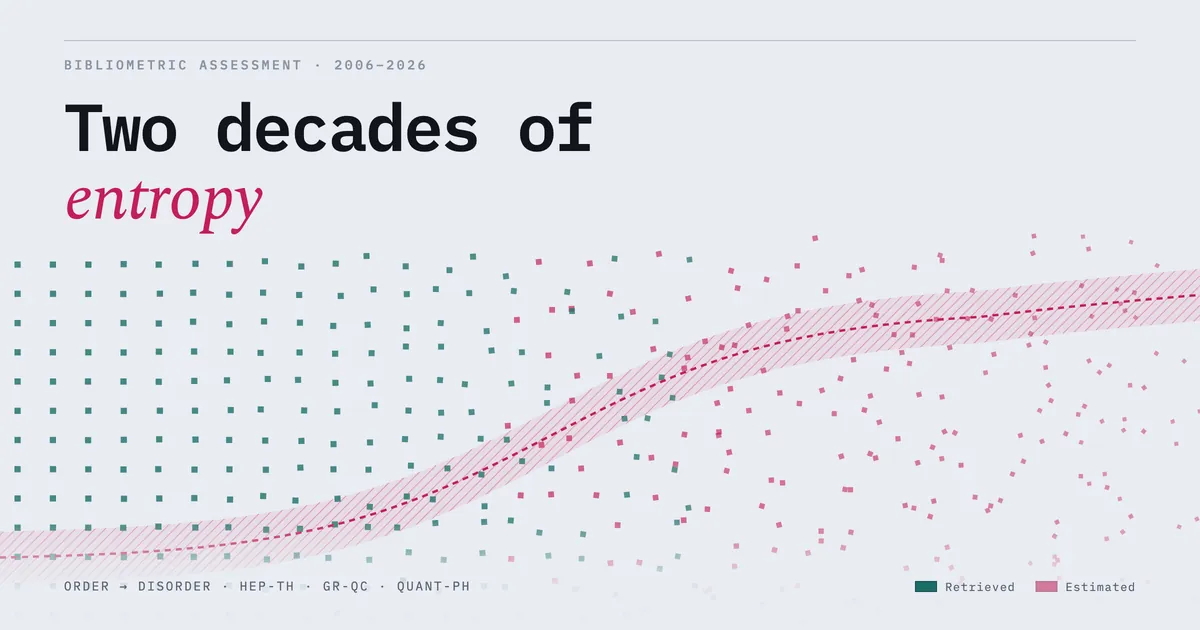
Entropy became one of the organizing concepts of 21st-century theoretical physics. This page quantifies how much of that is real topical concentration and how much is ordinary publication inflation — and is explicit about which numbers were retrieved and which were reasoned.
Scope: hep-th · gr-qc · quant-ph · cond-mat.stat-mech Sources: arXiv · INSPIRE-HEP · Web of Science · OpenAlex Solid teal — retrieved count from a named source Hatched crimson — reasoned estimate, not retrieved 40k–70kTheoretical-physics papers touching entropy, 2006–2026Estimate · title/abstract level >10,000Records in the entanglement-entropy subfield aloneEstimate 123,063Web of Science records in the only prior entropy bibliometric studyRetrieved · Li et al. 2019 3,869New hep-th preprints in 2020 — essentially flat year over yearRetrieved · arXiv Fig. 01The growth curve, with its uncertainty made visible
Annual output in the entanglement-entropy subfield — the fastest-growing and best-defined strand of the entropy literature. Every value here is an estimate, so the chart shows a per-year range rather than a line pretending to precision it does not have.
Estimated annual output — entanglement entropy, 2006–2025 Estimate Vertical bars give the plausible range for each year; the dashed line traces the midpoint. Markers flag the five datable events that moved the curve. 2026 is excluded as a partial year.The shape matters more than the absolute values. Output rises roughly an order of magnitude between 2006 and 2022, then plateaus — the signature of a subfield that has matured rather than one still compounding.
The plateau is not a decline in interest. It reflects diffusion: entropy work increasingly appears under quant-ph and cond-mat rather than hep-th, so a category-scoped count undercounts the topic's real reach in later years.
Growth outpaced the field — the baseline proves it
These are hard counts from arXiv's own submission statistics. They matter because they establish that the home categories of gravitational entropy work were not themselves growing.
arXiv new submissions, 2020 — HEP family Retrieved Source: arXiv:2109.06591. hep-th and gr-qc sit near 3,400–3,900 and have been roughly flat for years. arXiv new submissions, 2021 — broad areas Retrieved Source: arXiv official statistics. Total arXiv intake in 2021 was 181,630; physics fell below half of all submissions back in 2017.The comparison is the finding. Entanglement-entropy output rose from dozens to several hundred papers a year while hep-th and gr-qc stayed flat. The topic therefore gained share within its own categories — this is concentration, not inflation.
Faster-growing quant-ph and cond-mat absorbed much of the later entropy work, which is why the two literatures below drifted apart.
Cumulative accumulation
Running total of the estimated annual figures. The widening band is the honest part: uncertainty compounds along with the count.
Cumulative estimated records — entanglement entropy Estimate By end-2025 the running total reaches roughly 6,800–8,600 on these per-year bands. The headline figure of “over 10,000 records” is reconciled by adding 2026, journal versions of preprints, and cross-listed variants that a strict deduplicated title count excludes. Fig. 04What drove each surge
Subfield activity and the datable results that moved it. The years are hard; the band widths are qualitative and carry no count.
Subfield activity and milestone results, 2006–2026 Dates retrieved 2006 is a genuine watershed: Ryu–Takayanagi in holography and Kitaev–Preskill plus Levin–Wen in condensed matter appeared within months of each other, independently making entanglement entropy a central observable.2006 — Ryu–Takayanagi (hep-th/0603001) tied entanglement entropy in a CFT to the area of a minimal surface in AdS, making entropy a computable bridge between quantum information, field theory, and gravity.
2010 — Verlinde's entropic gravity produced a fast burst of derivative and rebuttal papers, then plateaued as a distinct topic.
2012 — The AMPS firewall reignited the information paradox. 2015 — quantum extremal surfaces supplied the technical bridge. 2019–20 — islands and replica wormholes delivered the steepest citation trajectory of the period.
Fig. 05Citations detect inflections earlier than counts
Annual publication counts lag a result by two to three years. Citation curves respond within months, which makes them the better instrument for locating a surge.
Landmark papers by approximate citation count Retrieved · approximate Counts are living, database-dependent snapshots — INSPIRE, Scopus, and Google Scholar routinely differ by 20–100% for the same paper. Strominger–Vafa is a 2010 SLAC/SPIRES snapshot and has grown since. The Hawking-radiation review reached its total in only a few years, which is the surge signature. Fig. 06The confound that ruins naive counts
One journal is large enough to distort any keyword search for entropy — and most of its content is not theoretical physics.
Handling ruleExclude Entropy (MDPI) as a source field before counting, or restrict to its physics sections. Never treat “papers in Entropy” as a proxy for “entropy papers.” Note that the sole prior bibliometric study of this topic was itself published in that journal and identifies it as a major node in its own citation network.
Annual output of the journal Entropy (MDPI) Retrieved Counts from the journal's own reviewer-acknowledgement editorials. Cumulative output is on the order of 14,000+ papers, overwhelmingly applied — signal processing, machine learning, biomedical entropy measures, complex systems. MethodWhy the sources disagree
Four mechanisms account for essentially all disagreement between databases:
- Title/abstract vs. full-text search. Full-text returns 5–20× more hits, most of them incidental mentions. The two must never be mixed in one figure.
- Preprint and journal double-counting. One result appears as an arXiv preprint plus one or more journal versions. INSPIRE deduplicates; Google Scholar largely does not.
- arXiv cross-listing. A paper tagged
hep-th+gr-qc+quant-phis counted up to three times in any category sum. - Coverage boundaries. INSPIRE covers HEP well but under-covers pure
cond-matandquant-phstatistical-mechanics work; Web of Science and Scopus cover journals but miss arXiv-only preprints.
“Theoretical physics” also has no clean database boundary. Entanglement entropy spans hep-th, gr-qc, quant-ph, cond-mat, and math-ph; reasonable analysts will draw the line differently and change the grand total by tens of percent.
Turning these estimates into hard counts
- Query the INSPIRE-HEP API directly. Title-level searches —
title "entanglement entropy",title "black hole entropy",title "island" and title "entropy"— reading the JSONhits.totalfield and exporting per-year histograms via theearliest_datefacet. Highest-value next step by a wide margin. - Cross-check against OpenAlex concept queries for a database-independent second opinion, and against Scopus for the
cond-mat/quant-phstrand that INSPIRE under-covers. - Anchor the quantitative narrative on entanglement entropy. It is the best-defined, most-citable, fastest-growing proxy; treat the other subfields as satellites.
- Detect inflections via citation dynamics, not annual counts. The 2006, 2010, 2012, and 2019 surges all appear earlier and more sharply in citation curves.
- Falsification tests. If a direct INSPIRE title count for entanglement entropy comes back under ~5,000 for the period, revise the >10,000 figure down. If hep-th/gr-qc submissions turn out to have grown more than 5% a year, soften the “outpaced the field” claim. Neither is expected — both are the correct checks.