Physics Atlas
Physics is fun!
physicsmathconceptsvisualizationgraphdomainsmechanicsquantumtensor
article
One page per concept, written to be linked
Physics Atlas isn't a course, and it isn't a wiki clone of an existing textbook. It's a working map — physics and math concepts each written as their own page: prose, build-time-rendered math, and, where it earns its place, an interactive 3D visualization. Every page exists to be found and connected, not scrolled through once.
How it's builtThree ideas the whole site runs on
id: domain/slugAddressed
A concept's identity is one string. It's the URL, the content file's path, and the graph node id, all at once — down to the section level, e.g. mechanics/noether-theorem#statement.
Composed
Pages link and transclude each other, so a definition gets written once and reused, with attribution, wherever it's needed. A link to a concept that doesn't exist yet isn't an error — it becomes an entry on the wanted list.
graph.jsonGraphed
Prerequisites, generalizations, derivations, and mentions mined from the text combine into one typed graph — an interactive map, and machine-readable at /api/graph.json, per concept, and as llms.txt.
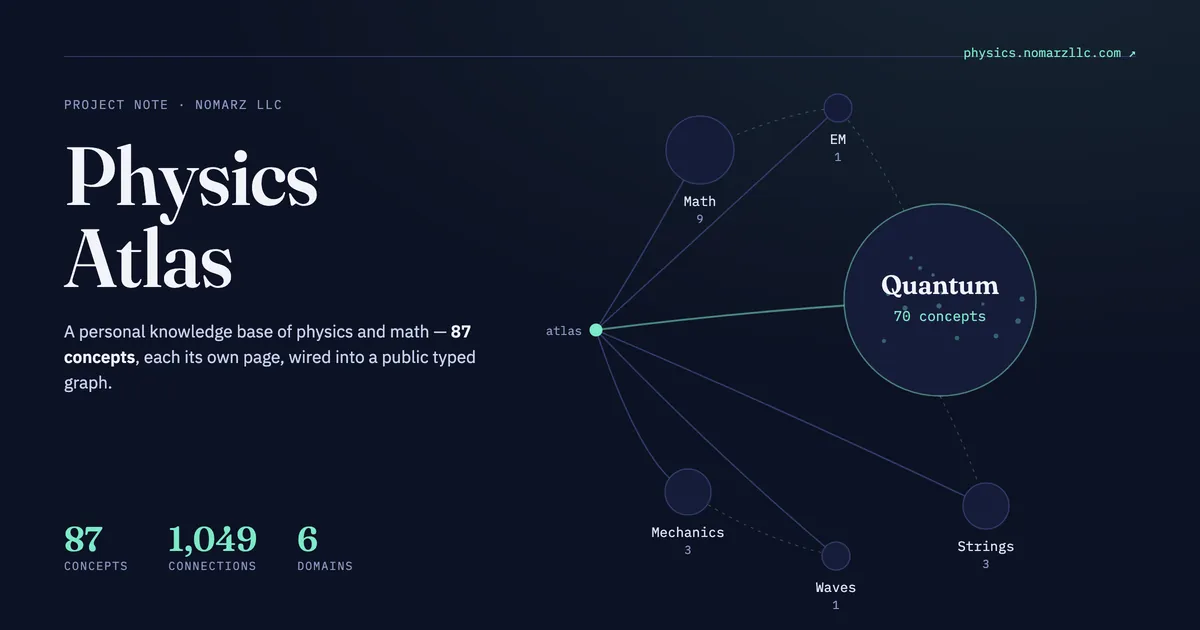
Where the 87 concepts sit
Quantum MechanicsPlanck to entanglement engineering, mapped as a century-long lineage 70 MathVectors, matrices, coordinates, tensor calculus 9 String TheoryWorldsheets, dualities, and one personal conjecture 3 MechanicsLeast action, Lagrangian form, Noether's theorem 3 ElectromagnetismMaxwell's four equations 1 WavesThe equation shared by strings, air, and light 1 One String Theory entry is original work, not a textbook summary: strings/theory-of-amir — a conjecture that a black hole collapses one spatial dimension across its horizon (D → D−1). It's filed as a normal node, on the same footing as Maxwell's equations.
“A model can already explain the standard version of a topic — the one that's been written a thousand times. What's left worth doing by hand is the harder version: a structured, personally-maintained map precise enough to hold your own additions to a field, not just the received material.”— the project's working assumption